
BEST COIR
PRODUCTS
SUPPLIER
Location
No.09, Pengiriwatte Mawatha, Mirihana, Nugegoda,
Colombo, Western Province, Sri Lanka.
Contact
+94 (0)76 791 4088
marketing@ecotrends.lk
BEST COIR
PRODUCTS
SUPPLIER
Location
No.09, Pengiriwatte Mawatha, Mirihana, Nugegoda,
Colombo, Western Province, Sri Lanka.
Contact
+94 (0)76 791 4088
marketing@ecotrends.lk
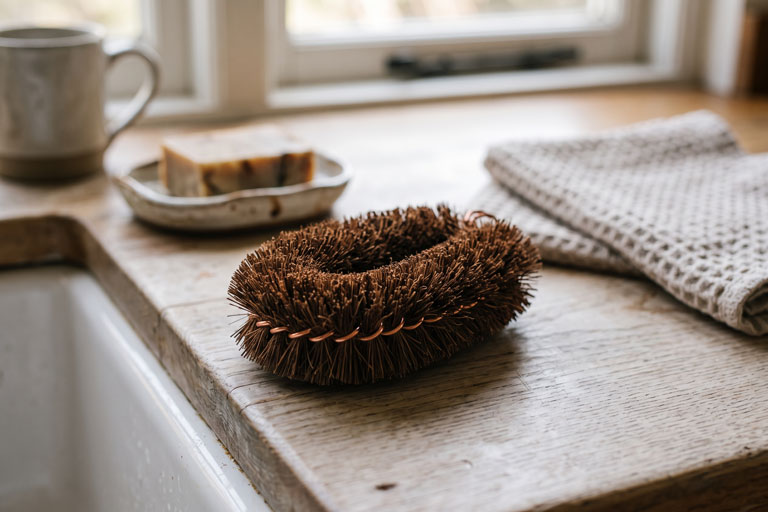
Walk into almost any kitchen in Japan and you’ll find a small, curved bundle of stiff natural bristles hanging by the sink. It looks humble. It costs very little. And it has quietly outperformed every plastic cleaning gadget invented in the hundred plus years since it first appeared. That little tool is the tawashi brush, and once you understand what it does, you’ll wonder why the rest of the world took so long to catch on.
So what exactly is it? A tawashi brush is a handheld scrubbing brush traditionally made from tightly bound natural palm or coconut fiber, shaped into a curved oval that fits comfortably in your palm. No handle, no plastic, no nonsense. Just densely packed fiber that scrubs pots, pans, vegetables, and sinks with surprising power.
The story starts in 1907, when a Japanese inventor named Shozaemon Nishio was watching his wife struggle with a worn-out mat she used for cleaning. The flat mat kept slipping and wouldn’t reach into curved pots. His fix was simple and clever: he rolled the fiber matting into a curved bundle and bound it with wire. The result gripped better, reached into corners, and lasted far longer. He called it the “kamenoko tawashi,” meaning “turtle shell scrubbing brush,” because its rounded shape looked like a little turtle.
The design was so good that it has barely changed since. The same company Nishio founded still makes them today, over a century later. Think about that for a moment. How many products from 1907 are still made the same way because nobody has managed to improve on them?
Traditional tawashi were made from hemp palm fiber, but as demand grew, makers turned to coconut coir, which is more abundant and every bit as effective. Coir comes from the husk of the coconut, and if you’re curious about the material itself, the Coco Coir entry on Wikipedia covers its properties in detail. Sri Lanka, where coconut cultivation spans thousands of years, became one of the world’s leading sources of this golden fiber, and skilled craftsmen there still produce tawashi style brushes by hand.
Honestly, this is where the old design embarrasses the new ones. Let me explain the main advantages one at a time.
The stiff coir bristles do the mechanical work that soap alone can’t. Burnt rice at the bottom of a pot, dried egg on a pan, tea stains in a mug. The fiber’s natural coarseness lifts them off with a few passes, often without any detergent at all. Less soap in your water means less soap in the environment, and your hands will thank you too.
A plastic sponge is basically a bacteria hotel. Its closed synthetic pores trap water and food particles, and within days it starts to smell. A tawashi does the opposite. The open fiber structure drains and air dries within hours, and coconut coir has a natural resistance to microbial growth. Pour boiling water over it once a week and you’ve done all the sanitizing it will ever need.
With basic care, a coir tawashi handles three to six months of daily scrubbing. Compare that with the two or three weeks most people get from a sponge before it turns sad and smelly. One of our long-term customers in Vancouver said, “I used this every single day through winter, and honestly it still looks almost new. I’ve stopped buying sponges completely.” We hear versions of that story constantly, and it never gets old.
When a tawashi finally wears out, you drop it in the compost. Coir fiber and the thin binding wire (remove the wire first if your brush has one) return to the earth. No microplastics, no landfill centuries. A plastic sponge can’t say any of that.
The classic use is dishwashing, but stopping there would be selling it short.
In the kitchen: scrub pots, pans, woks, and cast iron. The bristles clean seasoned cast iron without stripping the surface, which is something steel wool can never promise. Use it dry to sweep crumbs off cutting boards.
For vegetables: this might be the most underrated trick in Japanese home cooking. Scrub potatoes, carrots, burdock, ginger, and beets under running water instead of peeling them. You keep the nutrients and fiber in the skin, you waste less food, and it’s faster than peeling. Keep a separate tawashi just for produce if you like to keep things tidy.
In the bathroom and beyond: tiles, sink basins, garden tools, muddy boots, even plant pots before repotting. Anywhere you need firm scrubbing power, the little turtle delivers.
A quick tip from experience: when your kitchen tawashi starts feeling soft after months of use, don’t throw it out. Demote it to bathroom or garden duty and get another few months out of it. Waste nothing, as the original makers intended.
Rinse it under running water after use, squeezing gently to flush out food bits. Then hang it up or stand it bristles down so it drains. That’s genuinely the whole routine. The one mistake to avoid is leaving it soaking in a basin of water overnight, since constant saturation weakens the fiber binding over time.
If the brush picks up grease, a quick scrub against itself with a drop of dish soap and hot water sorts it out. Once a week, pour freshly boiled water over the bristles for a natural sanitize.
Not all brushes are equal, and the difference comes down to fiber quality and binding. Here’s what separates a brush that lasts six months from one that sheds in six days:
Sourcing matters as much as construction. Brushes made in coconut growing countries tend to use fresher, higher grade fiber simply because it doesn’t travel far. A quality fiber and coir products supplier like ECO TRENDS in Sri Lanka works with locally harvested coir and traditional binding methods, which is exactly the combination you want. Retailers and distributors looking to stock natural cleaning tools can contact us for fiber and coir products in bulk quantities.
It’s easy to feel like individual choices don’t matter against the scale of global plastic waste. And sure, one brush won’t fix the ocean. But the math of a household is real: swap sponges for a tawashi and you personally keep fifteen to twenty plastic sponges out of landfill every year. Multiply that across a street, a city, a country, and suddenly the humble turtle shell brush from 1907 looks less like nostalgia and more like the future.
Sometimes the old ways survive for a reason. This is one of those times.
Here’s a plot twist the original makers never saw coming. After decades of being displaced by cheap plastic sponges even in Japan, the tawashi is having a genuine global moment. Zero-waste shops from Portland to Berlin to Melbourne now stock them as a signature item. Home organizing influencers show them off next to wooden cutting boards and linen towels. Search interest in plastic-free kitchen tools has climbed year after year, and the little turtle brush keeps riding that wave.
Why now? Partly it’s the growing awareness of microplastics, which turned the innocent kitchen sponge into something people actively want to replace. Partly it’s aesthetics, since a natural fiber brush hanging by the sink simply looks better than a neon rectangle of polyurethane. And partly it’s the quiet satisfaction of using something made by hand from a renewable material, in a world where almost nothing else is.
The revival has also been good news for coconut growing regions. Rising demand for coir brushes supports fiber mills and craft workshops in Sri Lanka and southern India, where brush making provides steady rural employment. When you choose a tawashi over a plastic sponge, the benefit travels the whole length of the supply chain, from your kitchen sink back to the coconut grove. Not many small purchases can honestly claim that.
Traditional tawashi were made from hemp palm fiber, while most modern versions use coconut coir, the natural fiber from coconut husks. The fibers are tightly bound into a curved, palm-sized bundle, usually with a thin wire core, and contain no plastic at all.
Yes, and it’s one of the best tools for the job. The coir bristles remove stuck food without stripping the seasoning layer, unlike steel wool or harsh scourers. Many cast iron enthusiasts clean with only a tawashi and hot water.
With daily use, a well-made coir tawashi lasts three to six months in the kitchen. Rinsing after use and drying it bristles down extends its life considerably. Many people then use the softened brush for garden or bathroom cleaning for a few more months.
Absolutely. Scrubbing root vegetables like potatoes, carrots, and ginger is a traditional Japanese use for the tawashi. It removes soil while keeping the nutrient-rich skin intact, which means less peeling and less food waste.
Rinse it under running water after each use and let it air dry with bristles facing down. Once a week, pour boiling water over the fibers to sanitize naturally. Avoid soaking it overnight, as prolonged saturation weakens the fiber binding.
Yes. They’re made from renewable coconut or palm fiber, last months longer than synthetic sponges, shed no microplastics, and can be composted at the end of their life once any metal wire is removed.