
BEST COIR
PRODUCTS
SUPPLIER
Location
No.09, Pengiriwatte Mawatha, Mirihana, Nugegoda,
Colombo, Western Province, Sri Lanka.
Contact
+94 (0)76 791 4088
marketing@ecotrends.lk
BEST COIR
PRODUCTS
SUPPLIER
Location
No.09, Pengiriwatte Mawatha, Mirihana, Nugegoda,
Colombo, Western Province, Sri Lanka.
Contact
+94 (0)76 791 4088
marketing@ecotrends.lk
Search for how long do coir erosion control products last and you will get a genuinely confusing spread of answers. Two to five years, says one supplier. Twenty four to thirty six months, says another. Four to six years. Four to eight years. Up to three growing seasons. Nine months. All of those figures come from reputable sources, and none of them are wrong exactly, which is the frustrating part.
So what is going on? The short version is that people are answering different questions and calling them the same question. Let me explain, because once you see the distinction the numbers stop fighting each other.
Every coir product has a functional life and a breakdown life, and they are not the same thing.
Functional life is the period during which the material still does its job: holding soil, resisting flow, keeping seed in place. Breakdown life is the period until there is essentially nothing left of it. A blanket can stop being structurally useful at year three and still be visibly present at year five, slowly turning into leaf litter. A supplier quoting the shorter figure is being conservative. A supplier quoting the longer one is measuring the last visible fibre. Both are telling the truth.
When you are planning a project, the functional figure is the one that matters. Nobody cares whether traces of coir remain in year six. They care whether the slope is still held in the spring of year three.
Light grades around 400 gsm generally give one to two years of useful service, with full breakdown following a year or so behind. Middle grades near 700 gsm run to roughly two or three years. Heavy 900 gsm material commonly stretches to three or four years of function.
Rubberised and latex bonded rolls sit above that range again, because the binder slows microbial attack on the fibre. Exact figures vary with the binder and the loading, so this is a number to get from your specific supplier rather than from a general article.
One thing worth knowing: many blankets sold internationally include a polypropylene netting layer for tensile strength. The coir degrades on schedule and the plastic net does not. If full biodegradability is a project requirement rather than a preference, check the netting material, not just the fibre.
Logs generally outlast blankets, and the reason is simple geometry. A blanket is a thin layer with a huge surface area exposed to air, sun and soil organisms. A log is a dense cylinder where only the outer few centimetres meet the world. The core stays intact long after the skin has softened.
Expect somewhere in the range of two to five years of function for a standard density log, with breakdown running a year or two beyond that. Denser logs and larger diameters push the upper end higher. Logs sitting permanently below the waterline often outlast their dry counterparts by a comfortable margin, which surprises people.
Netting tracks the same weight based pattern as blankets, roughly one to two years for the lightest grades and three to four years for the heaviest. But netting has more of its surface exposed to sunlight than a blanket does, since there is no continuous fibre layer shading the yarn, so ultraviolet exposure plays a larger role. On a shaded north facing bank you will get more life than the sheet suggests. On an open south facing slope in a hot climate, plan for less.
These are the long lived members of the family, largely because they are usually placed where oxygen is scarce. Fill units used in constructed wetlands, gabion faces or below water in revetment gaps commonly hold together well past five years. Where they are exposed and dry, treat them like a heavy blanket.
Understanding these will tell you more than any single figure on a datasheet.
Here is the thing. How long do coir erosion control products last is rarely the actual question. The real question is whether the material will still be working on the day your vegetation is ready to take over the structural job. That is a matching exercise, not a durability contest.
A hydroseeded grass mix on a decent capping layer in a temperate climate might close over in one season. A native shrub and tree planting on a rehabilitated mine site might genuinely need four years before the root network holds the slope alone. Same product, entirely different specification, because the establishment period is different.
So work backwards. Ask your landscape designer or ecologist how long establishment will realistically take on this soil, in this climate, with this planting mix. Add a season of margin, because the first season rarely goes as planned. Then choose the grade whose functional life covers that window. Choosing on lifespan alone, without reference to the planting, is how projects end up with expensive heavy grade material on a site that vegetated in eleven months.
You will notice that published lifespan ranges are wide, and now you know why. A supplier serving Florida and a supplier serving Ontario are describing the same roll under conditions that differ by a factor of two. Neither is being dishonest. They are just quoting from their own field experience.
When you ask a supplier for a figure, give them the site conditions first: climate, aspect, whether the material will be submerged, and what is being planted. A quality fibre and coir products supplier should be able to narrow a five year range down to something usable once they know those four things. If they quote the same number regardless of what you tell them, that is worth noticing.
A civil contractor working highway embankments in the Pacific Northwest gave us a line we still quote. I used this as a two season product on a job where the design assumed one, purely because our grass mix was slow, and it held right through the second winter without a repair visit. That second winter is where the money is. Repair mobilisations cost far more than the difference between grades.
Our customers are really happy with the way heavier grades behave in the second year specifically, and they usually put it the same way: the first year any product looks fine, and you only find out what you actually bought in year two.
Being honest about this builds more trust than overselling. If your design needs permanent reinforcement lasting twenty years or more, coir is not the material. Retaining wall backfill, foundation separation layers, landfill cap reinforcement; those want a synthetic geotextile, and no amount of extra gsm changes that. Coco coir is a plant fibre from coconut husk, and controlled decay is the feature it is built around, not a flaw to engineer away.
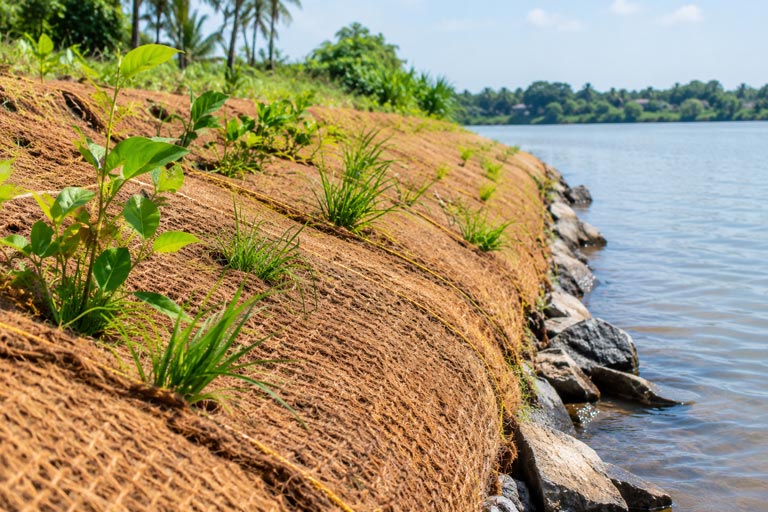
Where coir wins is anywhere the material is supposed to hand its job over to living roots and then quietly leave. Stream banks, shorelines, revegetated slopes, wetland edges, park landscaping, mine rehabilitation. On those sites the fact that it disappears is the whole reason to buy it.
Roughly one to two years for 400 gsm grades, two to three years for 700 gsm, and three to four years for 900 gsm, measured as functional life. Visible breakdown continues for a year or two beyond that. Warm humid climates shorten these figures and cool climates extend them.
Usually yes. A log is a dense cylinder with only its outer surface exposed, while a blanket is a thin layer with far more surface area meeting soil, sun and air. Standard density logs commonly give two to five years of function, and logs sitting below the waterline often last longer still.
Two reasons. Some quote functional life and others quote the time until nothing visible remains, which can differ by two years. And field experience varies enormously with climate, so a supplier serving a tropical market genuinely sees shorter service life than one serving a temperate market.
Yes. Permanently submerged coir degrades slowly because the low oxygen conditions restrict the microbes that break down the fibre. This is why coir pillows and logs used in constructed wetlands and below waterline revetments give such good service life.
The coir fibre itself is, and it breaks down into organic matter that enriches the surrounding soil. However, many erosion control blankets sold internationally include a polypropylene netting layer for strength. If full biodegradability is a project requirement, specify biodegradable netting explicitly.
Start from the vegetation, not the product. Ask how long establishment will realistically take on your soil and climate with your planting mix, add a season of margin, then pick the grade whose functional life covers that window.
Rubberised and latex bonded products last longer than untreated material, and site conditions help too. Shade, cool climate, stable moisture and poor soil biology all slow decomposition. Rapid vegetative cover also protects the material from ultraviolet exposure.
So, how long do coir erosion control products last in practice? Somewhere between one and five years of useful function, driven mainly by product weight, product form and site conditions, with breakdown trailing behind. But the figure that should shape your specification is not the maximum lifespan on the datasheet. It is the establishment period of whatever you are planting. Match those two and the material does exactly what it was designed to do. If you want a grade recommendation against real site conditions, contact for fiber and coir products with your climate, aspect and planting plan.