
BEST COIR
PRODUCTS
SUPPLIER
Location
No.09, Pengiriwatte Mawatha, Mirihana, Nugegoda,
Colombo, Western Province, Sri Lanka.
Contact
+94 (0)76 791 4088
marketing@ecotrends.lk
BEST COIR
PRODUCTS
SUPPLIER
Location
No.09, Pengiriwatte Mawatha, Mirihana, Nugegoda,
Colombo, Western Province, Sri Lanka.
Contact
+94 (0)76 791 4088
marketing@ecotrends.lk
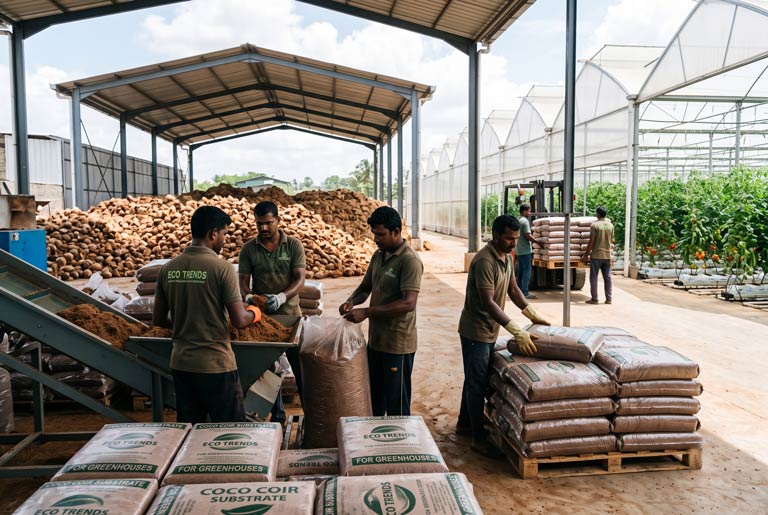
Every supplier sends attractive samples. That’s expected. The real test comes months later, when crops are deep into production and small inconsistencies start to show.
Choosing greenhouse coir substrate suppliers isn’t about finding the cheapest option. It’s about finding someone who delivers the same material, behaving the same way, shipment after shipment.
For commercial growers, that reliability shapes entire seasons.
Where coir comes from matters less than how it’s handled.
Washing cycles remove excess salts. Buffering stabilizes nutrient exchange. Drying and compression determine how the substrate expands and drains. When these steps are controlled, the material behaves predictably in the greenhouse.
Suppliers who manage their own processing tend to maintain tighter quality control than those relying on fragmented sourcing.
Marketing materials rarely explain what happens when substrates age under constant irrigation.
Growers want to know how EC drifts over time, how fiber breaks down, and how roots respond late in the cycle. Those answers usually come from experience, not sales sheets.
Understanding the raw material helps, and neutral references on coir fiber properties provide helpful context without exaggeration.
Substrate delays don’t stay isolated. They ripple outward pushing planting dates, straining labor planning, and affecting market supply.
Professional suppliers plan around shipping windows, port congestion, and regional regulations. This matters for growers shipping produce to export markets where timing is tight.
That’s why many operations build long-term relationships with dependable commercial coir product suppliers rather than switching sources frequently.
Communication is part of the product
Here’s the thing: growers don’t just buy substrate. They buy clarity.
When irrigation strategies change or crops behave unexpectedly, suppliers who can explain material behavior become partners. Those who disappear after delivery don’t last long in professional circles.
Many greenhouse managers maintain direct communication channels and rely on supplier contact teams for specifications, lead times, and technical clarification.
Sustainability that fits real operations
Coir substrates appeal to growers not because they’re trendy, but because disposal and environmental impact are easier to manage than synthetic alternatives.
As pressure increases from retailers and regulators, that practicality becomes part of operational planning rather than a marketing point.
FAQs – Greenhouse Coir Substrate Suppliers
1. How can growers verify substrate consistency?
By comparing EC, expansion rate, and fiber structure across shipments.
2. Does supplier location matter?
Processing quality matters more than geography.
3. Should lab reports be requested?
Yes. Reputable suppliers provide them readily.
4. How early should substrate orders be placed?
Several months ahead is common for commercial volumes.
5. Can suppliers customize substrate blends?
Some can, particularly those with in-house processing facilities.