
BEST COIR
PRODUCTS
SUPPLIER
Location
No.09, Pengiriwatte Mawatha, Mirihana, Nugegoda,
Colombo, Western Province, Sri Lanka.
Contact
+94 (0)76 791 4088
marketing@ecotrends.lk
BEST COIR
PRODUCTS
SUPPLIER
Location
No.09, Pengiriwatte Mawatha, Mirihana, Nugegoda,
Colombo, Western Province, Sri Lanka.
Contact
+94 (0)76 791 4088
marketing@ecotrends.lk
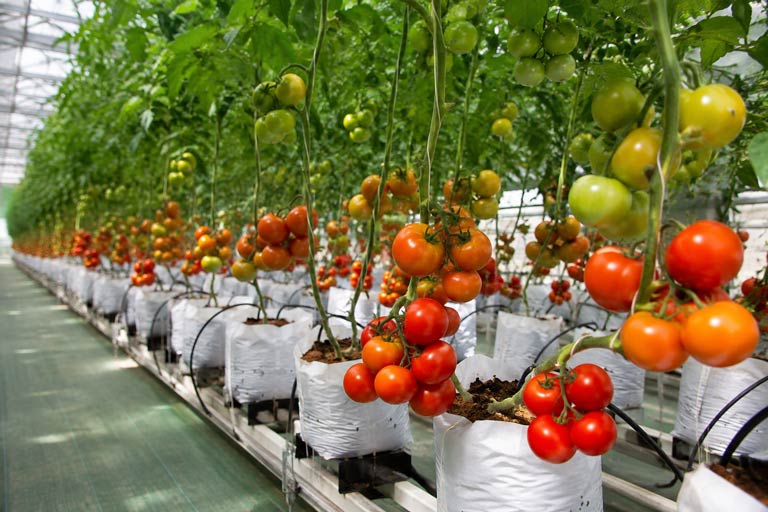
When greenhouse production moves beyond small trials, commercial tomato grow bags stop being a convenience and start behaving like infrastructure. At scale, even small inconsistencies repeat themselves hundreds or thousands of times, and tomatoes are quick to show when something isn’t right.
Grow bags gained popularity not because they look tidy, but because they bring order to a system that can otherwise drift. Uniform volume. Predictable drainage. Repeatable results. Those qualities matter when you’re managing crops across seasons and markets.
Here’s a quiet truth about commercial farming: perfection is unrealistic, but consistency is achievable.
Grow bags create a standardized root zone that allows growers to make informed irrigation decisions. When every bag behaves similarly, it’s easier to fine-tune nutrient delivery instead of reacting to random plant stress.
This uniformity becomes especially important in high-wire tomato systems, where crops remain productive for extended periods and small imbalances compound over time.
Root control without constant intervention
Tomato roots are aggressive by nature. Left unchecked, they’ll compact poorly structured media and restrict their own oxygen supply. Well-made grow bags limit that behavior gently, guiding roots outward instead of downward into dense layers.
The result is a root system that stays active longer, even during peak production. That’s not just a plant health benefit—it’s a management benefit. Fewer surprises mean fewer emergency adjustments.
Grow bags simplify tasks that often get overlooked: placement, spacing, replacement, and sanitation.
When staff turnover is high, systems that reduce decision-making help protect the crop. Bags arrive ready to use, with consistent dimensions and predictable behavior. Training becomes easier. Mistakes become less frequent.
Many tomato operations pair grow bags with cucumber crops as well, using similar formats to streamline workflow across greenhouses.
Poor-quality bags rarely fail immediately. They struggle quietly.
Mid-season, fibers begin breaking down unevenly. Drainage slows. EC becomes harder to stabilize. By the time symptoms appear in the plants, corrective options are limited.
This is why experienced growers evaluate suppliers based on long-term performance rather than first impressions. Understanding the fiber itself helps here, and references explaining coconut coir as an agricultural material offer useful background without commercial bias.
Price matters but only up to a point.
Growers supplying retail or export markets depend on predictable inputs. Missed shipments or inconsistent bag quality disrupt planting schedules and labor planning. That’s why many operations work with established quality fiber and coir product suppliers who can deliver consistent specifications season after season.
Sri Lanka’s role as a major coir-processing region often comes into play here, especially when suppliers manage production internally.
When something shifts weather patterns, irrigation schedules, nutrient recipes growers need answers, not silence.
Suppliers who maintain open communication channels become problem-solvers, not just vendors. Many greenhouse managers keep direct lines open and use dedicated grow bag contact teams when planning volume orders or requesting technical details.
That relationship often matters more than a minor price difference.
1. How many tomato plants fit in one grow bag?
Most commercial setups place two to three plants per bag, depending on volume and variety.
2. Are grow bags suitable for long-cycle tomatoes?
Yes, provided the fiber structure maintains drainage and oxygen availability.
3. Do grow bags work for hydroponic systems?
They’re commonly used in drip-fed hydroponic greenhouses.
4. Can the same bags be used for cucumbers?
Yes. Many operations standardize bag formats across crops.
5. What causes uneven growth in grow bags?
Inconsistent watering, EC imbalance, or uneven compaction during setup.