
BEST COIR
PRODUCTS
SUPPLIER
Location
No.09, Pengiriwatte Mawatha, Mirihana, Nugegoda,
Colombo, Western Province, Sri Lanka.
Contact
+94 (0)76 791 4088
marketing@ecotrends.lk
BEST COIR
PRODUCTS
SUPPLIER
Location
No.09, Pengiriwatte Mawatha, Mirihana, Nugegoda,
Colombo, Western Province, Sri Lanka.
Contact
+94 (0)76 791 4088
marketing@ecotrends.lk
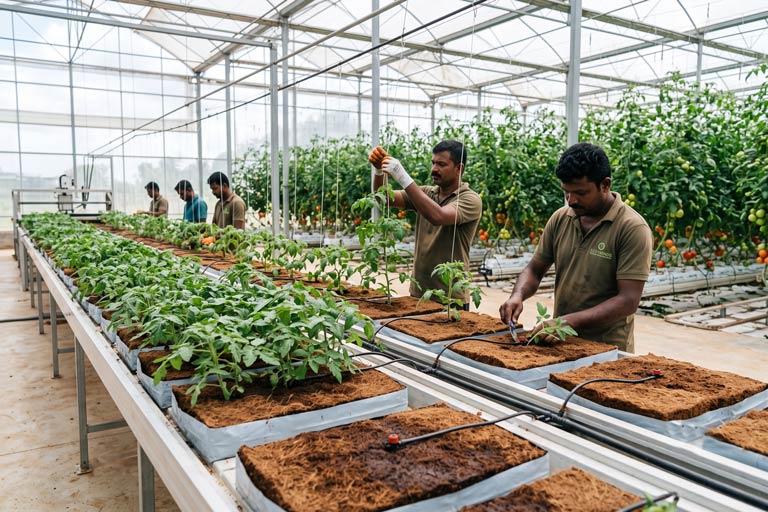
For growers managing large greenhouse operations, coir slabs for tomatoes are rarely an experimental choice. They usually enter the picture after something stops working—uneven plant vigor, unpredictable drainage, or roots that look stressed long before the season should end.
Tomatoes are sensitive. They demand balance. Not perfection, but consistency. And that’s where coir slabs quietly earn their place in professional tomato production across the USA, Canada, Germany, Japan, and the Middle East.
The real value isn’t hype. It’s control.
Healthy tomato production starts underground. When coir slabs are processed correctly, roots spread evenly instead of circling or clumping. Oxygen remains available even after repeated irrigation cycles. Moisture stays accessible without drowning the plant.
That structure doesn’t happen by accident. Fiber length, washing quality, and buffering all play a role. When those factors line up, growers notice fewer stress signals and more predictable plant behavior.
It’s one of those improvements you feel more than you see until harvest numbers confirm it.
Here’s the thing: tomatoes don’t respond well to surprises. Sudden dry pockets or waterlogged zones force growers into constant correction.
Coir slabs distribute moisture laterally as well as vertically. That matters when several plants share the same slab. Instead of chasing imbalance, irrigation strategies become calmer and easier to adjust.
If you want a neutral, technical explanation of why this material behaves the way it does, the background on coconut coir as a growing medium explains the natural fiber structure without any sales language attached.
It sounds contradictory, but coir works globally because it doesn’t overreact.
In colder regions, slabs warm faster than traditional soil beds. In hot climates, they drain efficiently enough to protect roots from prolonged saturation. That’s why similar coir specifications are used in tomato greenhouses from Mexico to Russia.
The deciding factor isn’t geography. It’s processing discipline. Growers often rely on experienced quality fiber and coir product suppliers that control washing, buffering, and compression instead of outsourcing those steps.
Most issues don’t show up in week one. They appear mid-season.
Drainage slows. EC becomes harder to stabilize. Roots lose their bright appearance. In many cases, the cause traces back to poorly washed raw material or inconsistent fiber grading.
Once slabs are installed, fixing those problems is nearly impossible. That’s why commercial growers ask tougher questions before placing volume orders, not after the crop is already in place.
Substrate decisions affect more than plant health. They influence planting schedules, labor allocation, and market timing.
Reliable suppliers understand this. They communicate lead times clearly and provide technical support when conditions shift. Many growers maintain direct communication channels and use dedicated coir product contact points when planning future seasons or requesting specifications.
It’s less about transactions and more about continuity.
Coir slabs appeal to many growers not because they’re fashionable, but because disposal is simpler than synthetic alternatives. The material originates from coconut husks, a byproduct that would otherwise go to waste.
For growers balancing productivity with environmental responsibility, that detail carries practical weight.
1. How long can tomato crops remain productive in coir slabs?
With proper irrigation and nutrient control, slabs support full long-cycle tomato production.
2. Are coir slabs suitable for hydroponic systems?
Yes. They are widely used in drip-fed hydroponic greenhouses.
3. Do slabs require buffering before use?
Commercial-grade slabs are typically pre-buffered, but specifications should always be confirmed.
4. How do coir slabs compare with rockwool?
Many growers find coir more forgiving in moisture management and easier to dispose of after use.
5. Can coir slabs be reused?
Reuse is possible in some cases, but disease risk and physical degradation must be evaluated carefully.