
BEST COIR
PRODUCTS
SUPPLIER
Location
No.09, Pengiriwatte Mawatha, Mirihana, Nugegoda,
Colombo, Western Province, Sri Lanka.
Contact
+94 (0)76 791 4088
marketing@ecotrends.lk
BEST COIR
PRODUCTS
SUPPLIER
Location
No.09, Pengiriwatte Mawatha, Mirihana, Nugegoda,
Colombo, Western Province, Sri Lanka.
Contact
+94 (0)76 791 4088
marketing@ecotrends.lk
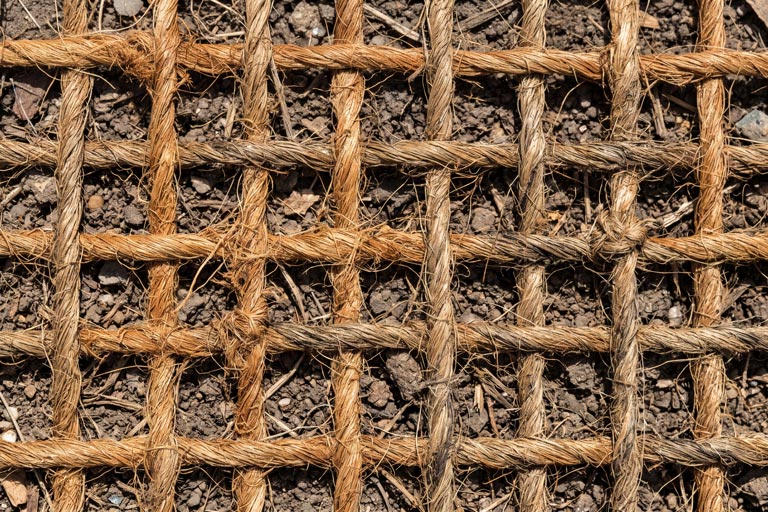
Ask three suppliers for coir geotextile specifications and you will probably receive three sheets that look nothing alike. One leads with weight. Another leads with a product code nobody outside that factory recognises. The third buries the useful figures on page two, underneath a large photograph of a very green hillside. And there you are, trying to work out whether the roll quoted at 700 gsm is the same thing as the one called MT700, and whether either of them is going to hold your slope through a wet season.
Here is the thing, though. Underneath all that packaging, coir netting is a fairly simple product. Only about six numbers genuinely decide how it behaves on the ground. Once you know which six, comparing quotes stops feeling like guesswork and starts feeling like arithmetic.
Grams per square metre. That is the figure everything else hangs off. It tells you how much coconut fibre sits in each square metre of the mesh, and more fibre means more mass to resist flowing water, more shade over bare soil, and a longer road to full breakdown.
If you want something you can feel rather than calculate: a 400 gsm net handles roughly like a heavy canvas tote bag. A 900 gsm net, when you pick up a corner of it, feels closer to a doormat. That difference in the hand is the difference on the slope too.
Mills across South Asia use their own trade codes for the same weights, which is where most of the confusion comes from. H2M8, MT700, 900 GSM Woven Coir Mesh; strip away the branding and you are usually looking at one of three standard grades.
Around 400 gsm sits at the light end. It suits gentle gradients, low flow situations, and sites where you expect grass or a cover crop to knit together quickly. Landscaped banks, park edges, garden terracing. It is also the cheapest way to keep seed and topsoil where you put them through one rainy season.
Around 700 gsm is the workhorse, and honestly it is what most projects end up specifying. Moderate slopes, drainage swales, highway embankment work, restoration sites where establishment is going to take two seasons rather than one. If a designer has not told you otherwise, 700 is usually the safe assumption.
Around 900 gsm is the heavy grade. Steep cut faces, channels carrying real velocity, shorelines, anywhere the vegetation is going to need three or four years to take proper hold. It costs more per square metre and it costs more to handle on site, so nobody specifies it casually.
Weight tells you how much fibre. Mesh opening tells you how that fibre is arranged, and the two together decide performance far more than either one alone.
A tight weave, with small apertures, holds fine soil and small seed beautifully. It can also smother a slow germinating species and make life difficult if you are planting plugs through the mesh. A wide open weave lets your plugs through without a fight, and lets your topsoil through as well when the first hard rain arrives. There is no correct answer here, only a trade off, and the right side of that trade off depends on whether your site is being hydroseeded or hand planted.
Ask for the open area as a percentage rather than the aperture in millimetres. Percentage open area is comparable across suppliers. Aperture measurements are taken differently in different factories and they quietly stop matching.
Any supplier will quote you a dry tensile strength. Fewer will quote the wet figure without being asked, which is a shame, because the wet figure is the one that matters. Your net is not going to fail on a dry Tuesday. It is going to be tested at three in the morning during the storm nobody planned for.
Coir holds its strength when saturated far better than jute does, which is one of the main reasons it displaced jute on serious civil works. Ask for both figures, machine direction and cross direction, and ask whether the wet value was measured after full soaking or after a brief dip. The two are not the same test.
Rolls typically run from one metre up to four metres wide, in lengths somewhere between 25 and 50 metres. That sounds like a boring logistics detail. It is not.
Every overlap between adjacent rolls is a seam you have to shingle correctly and staple twice. Go from a two metre roll to a four metre roll on a wide embankment and you have halved the number of seams, which cuts staple consumption and cuts crew hours. The catch is that a four metre roll of 900 gsm material is heavy enough that two people cannot comfortably walk it up a slope, so you may need machinery you had not budgeted for. Ask for the roll weight, not just the dimensions.
These are the fields that separate a quote you can trust from a quote you will argue about later.
Gradient first. On slopes gentler than about one in three, a light grade usually copes. Between one in three and one in two, most designers reach for the middle weight. Steeper than one in two and you are into the heavy grade, with anchor spacing tightened accordingly.
Then flow. A slope shedding sheet flow is a different problem from a channel concentrating that flow into a defined path. Channels want heavier material and they want it trenched in properly at the edges, because water finds the seam you were careless with.
Then time. This is the one that gets skipped. How long will the vegetation actually need? A hydroseeded grass mix on a fertile capping layer might close over in a single season. A native shrub planting on a poor mine spoil might take four years. Your netting needs to still be doing its job on the day the roots take over, not two seasons before.
One more thing worth saying plainly: whatever the sheet says, the project designer’s calculation wins. A supplier can tell you what a grade does. Only the designer knows what your particular site is going to throw at it. If you want a second opinion on grade selection, the technical team at a quality fibre and coir products supplier will normally read a site plan for you before you order, and that conversation costs nothing.
A restoration contractor working stream banks in Ontario put it better than any brochure could. I used this as a straight swap for the synthetic mat we had been specifying for years, and the inspectors stopped asking us about retrieval, because there is nothing left to retrieve. That single sentence explains most of the shift we have watched happen across the sector.
Our customers are really happy with the 700 gsm grade in particular, and they tend to say the same three things. It lies flat instead of curling in the sun. It does not go brittle at the edges after the first dry spell. And the grass comes through it roughly when the seed supplier said it would, which makes handover meetings a great deal calmer.
You can buy the correct grade and still watch it fail, and the reason is nearly always installation. Coir netting works by staying in continuous contact with soil. Lift it a centimetre off the surface over a clod you did not remove, and water runs underneath it in a neat little tunnel, taking your topsoil with it.
So: grade the surface properly, take out the rocks and the clods, cut a real anchor trench at the top of the slope and backfill it, unroll downslope rather than across, shingle upstream sections over downstream ones, and staple at the density the specification asked for rather than the density that felt sufficient at four in the afternoon. Then go back after the first serious rainfall and re anchor whatever lifted. That inspection is worth more than any upgrade in grade.
Worth being straight about this. If your design intent is permanent structural reinforcement, a synthetic geotextile is the correct product and coir is not. Coir is engineered to lose strength on a schedule. That is the entire point of it. Coco coir comes from the husk of the coconut, it is a byproduct of a food crop rather than a purpose grown material, and it returns to the soil as organic matter once the roots have taken over the structural job.
Where that matters most is in and around water. Synthetic netting persists in a watercourse indefinitely and carries a documented entanglement risk for small wildlife. On sensitive sites the specification increasingly rules it out regardless of unit cost. On a retaining wall foundation, it remains exactly the right choice. Different tools, different jobs.
Grams per square metre, which is the mass of coconut fibre in each square metre of the mesh. Higher gsm means more fibre, more resistance to flowing water and a longer service life. The three common grades are roughly 400, 700 and 900 gsm.
On gradients steeper than about one in two, most designers specify the 900 gsm grade with tightened anchor spacing. Between one in three and one in two, the 700 gsm grade is the usual choice. Always check against the project designer’s own calculation, because rainfall intensity and flow velocity shift the answer.
Coir retains its tensile strength when saturated considerably better than jute or straw based products, which is why it took over on serious civil works. It does lose some strength, so ask your supplier for the wet tensile figure in both machine and cross direction rather than the dry figure alone.
Rolls generally run from one metre to four metres wide and from 25 to 50 metres long. Wider rolls mean fewer seams, less stapling and lower labour cost, but heavier rolls that may need mechanical handling on site. Ask for the roll weight before you plan the crew.
Usually before, so the seed sits in direct contact with prepared topsoil and the netting protects it from washing away. Some specifications call for seeding through the mesh instead, which suits plug planting and open weave grades. Follow whichever the project specification states.
Netting is an open woven mesh of spun coir yarn, so you can see through it and plants grow through the openings. A blanket is a continuous layer of loose coir fibre held between netting layers, giving full surface coverage and more insulation for germinating seed. Netting suits reinforcement and planting, blankets suit seed protection.
Yes, and submerged coir often outlasts material exposed to repeated wetting and drying, because degradation slows without oxygen. It is used routinely in constructed wetlands, channel linings and shoreline works below the waterline.
Comparing coir geotextile specifications gets much easier once you stop reading the product names and start reading six figures: weight, tolerance, open area, wet tensile strength, roll dimensions and treatment. Line those up across three quotes and the differences show themselves immediately. If you would rather talk it through against an actual site plan, contact for fiber and coir products and send the gradient, the expected flow and the establishment period. That is usually enough to narrow it to one grade in a single conversation.