
BEST COIR
PRODUCTS
SUPPLIER
Location
No.09, Pengiriwatte Mawatha, Mirihana, Nugegoda,
Colombo, Western Province, Sri Lanka.
Contact
+94 (0)76 791 4088
marketing@ecotrends.lk
BEST COIR
PRODUCTS
SUPPLIER
Location
No.09, Pengiriwatte Mawatha, Mirihana, Nugegoda,
Colombo, Western Province, Sri Lanka.
Contact
+94 (0)76 791 4088
marketing@ecotrends.lk
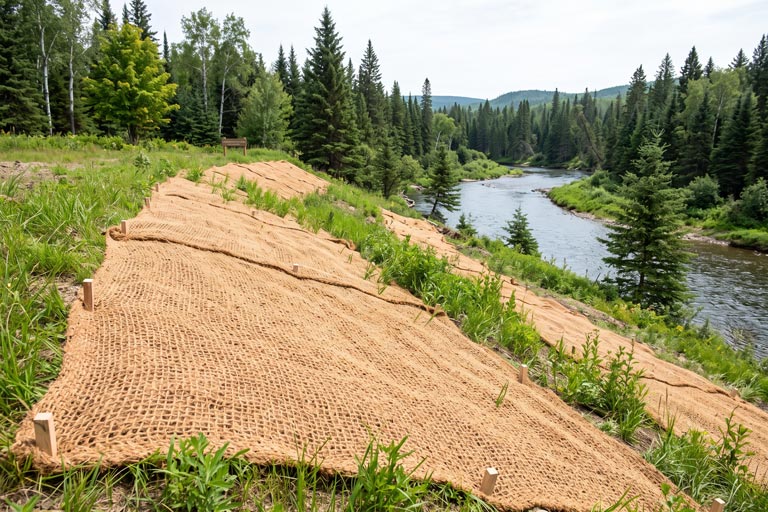
Water moves earth. Anyone who has watched a spring melt tear a fresh channel down a bare slope knows the feeling of helplessness that comes with it. That is the problem coir erosion control blankets Canada sites turn to, again and again, when a hillside, a ditch, or a riverbank needs holding together long enough for nature to take back over. And the beauty of it is that the fix is made from coconut husk, of all things.
This corner of the coir world gets less attention than the grow bags and greenhouse substrates, but for civil contractors, landscapers, and restoration crews, it solves a very real and very expensive headache. Let us get into how.
Picture a bare slope after construction. No roots holding the soil, nothing breaking the force of rain, and every downpour carrying precious topsoil into the storm drain. A coir blanket is a woven or matted layer of coconut fibre laid over that exposed ground. It does three jobs at once, and it does them quietly.
That third point is the clever part. The blanket is not meant to last forever. It is meant to buy time. Grass and native plants germinate through the mesh, their roots stitch the slope together, and by the time the coir breaks down, living roots have taken up the job. It is a handoff, plant to plant, husk to root.
Plenty of erosion products are plastic. They work, sort of, but they leave behind netting that traps wildlife and lingers in the soil for decades. Coconut fibre erosion blankets do the same job and then simply return to the earth. No microplastics, no cleanup, no guilt.
Coir also happens to be tough. Among natural fibres it is one of the most durable and rot resistant, which is exactly what you want in a material that spends its whole working life wet. A cotton or jute product might give you a season. Biodegradable erosion control matting made from coir can hold structure for several years, long enough for even slow establishing vegetation on a difficult northern site to get properly rooted.
One landscape contractor we supply put it this way. He said, "I used this on a highway embankment that had failed twice with plastic mesh, and it was the first product that actually held through a full freeze thaw winter." That freeze thaw endurance is a big deal in Canada, where the ground heaves and shifts in ways gentler climates never see.
Not every site needs the same weight of blanket, and picking the right one saves both money and grief. Coir blankets come in different densities, usually measured in grams per square metre, and the steeper or more exposed the slope, the heavier you go.
A gentle roadside verge might do fine with a lighter mat. A steep cut slope beside a new highway, battered by runoff, calls for a dense, high strength blanket. Coir netting for slope restoration on the most extreme grades sometimes gets paired with additional anchoring, staked down hard so it cannot slip before the vegetation grabs hold. When in doubt, the honest move is to describe your site to a supplier and let them steer you, rather than guessing and under specifying.
Slopes are only half the story. Water's edge is where erosion gets really stubborn, and that is where coir logs come in. These are dense cylinders of coconut fibre wrapped in netting, staked along a bank or shoreline to break wave energy and trap sediment.
Coir logs for shoreline stabilization are a favourite on lake edges and riverbanks across Canada, partly because they look natural and partly because they become planting beds. Crews often plug native wetland species straight into the logs, and as those plants root, the living shoreline replaces the fibre. It is restoration that improves as it ages, which is a rare and lovely thing in civil work.
Our customers are really happy with how the logs perform on softer banks, and one restoration lead told us, "the logs held the toe of the bank steady through the whole first season, and by year two the sedges had taken over completely." That is the goal, the product fading as the ecosystem strengthens.
Here is a practical bonus. Because coir products are natural and biodegradable, they often sail through environmental permitting more smoothly than synthetic alternatives, especially near water where regulators are understandably twitchy about plastics. Natural erosion control products Canada agencies review tend to fit neatly into green infrastructure guidelines.
And the material's origin adds to the case. Coir is a byproduct of the coconut industry, husk that would otherwise be discarded. Using it for erosion control turns waste into function, which is precisely the kind of circular story that modern project specs increasingly demand. If you want the neutral background on the fibre itself, Wikipedia gives a clear rundown of where it comes from and how it is processed.
It helps to picture the actual sites where this material earns its living, because erosion control can sound abstract until you see it in context. Highway and road construction is a big one. Every new cut and fill slope beside a Canadian road is a fresh erosion risk until vegetation locks it down, and blankets bridge that gap through the vulnerable early months.
Then there is land development, where builders strip vegetation, reshape terrain, and leave broad expanses of bare earth exposed to weather. Stormwater regulations increasingly require erosion protection on these sites, and coir products tick the box while also keeping sediment out of nearby waterways, which keeps both the regulators and the neighbours happy.
Reclamation work is a particularly satisfying use. Old mine sites and quarries leave harsh, steep, nutrient poor ground that struggles to revegetate. A coir blanket holds seed and the thin applied soil in place long enough for hardy pioneer plants to gain a foothold, kickstarting a recovery that might otherwise never begin on its own.
Coir blankets are not the cheapest erosion product on the market, and a project manager staring at a budget might be tempted by a cheaper synthetic roll. Fair enough. But the real cost of erosion control is not the roll price. It is the cost of failure, the redo, the sediment fines, the washed out slope after a storm.
Seen through that lens, a durable natural blanket that holds through a freeze thaw winter and then quietly disappears into the soil looks like a bargain. You pay once, it works, and there is nothing to remove or dispose of afterward. On a difficult slope or a sensitive shoreline, that reliability and that clean exit are worth every extra dollar, and experienced crews tend to learn this lesson the expensive way before they learn it the smart way.
Getting a coir blanket to perform comes down to a few basics that experienced crews swear by. Prepare the surface first, smoothing out ruts and removing debris so the blanket sits flush against the soil with no gaps for water to sneak under. Then anchor it properly.
Trench the top edge and bury it so runoff cannot lift the leading edge and peel the whole thing off. Overlap adjacent blankets in the direction of water flow, like shingles, and stake at the spacing the manufacturer recommends. Seed either before laying the blanket or through it, depending on the system. None of this is rocket science, but skip a step and you will be back reinstalling after the first heavy rain. To match the right blanket or log to your specific site conditions, it is worth reaching out to contact a fiber and coir products team who can spec the density and format for the job.
For procurement teams who like a formal reference for their material submittals, the coir entry on Wikidata ties the fibre to its broader classification and can be useful documentation.
The performance gap between a good coir blanket and a cheap one is wide. Density, fibre quality, and the strength of the netting all determine whether the product holds through a hard winter or shreds by spring. A quality fiber and coir products supplier with real processing heritage will offer consistent weight, clean fibre, and netting rated for the loads you are dealing with. On erosion projects, where a failure means redoing the whole job, that reliability pays for itself many times over.
Depending on density and conditions, most coir blankets hold structural integrity for two to four years. That window is designed to match how long vegetation needs to establish roots deep enough to stabilize the slope on its own.
Yes. Coir is among the most durable and rot resistant natural fibres, and quality blankets hold up through freeze thaw cycles that break down lighter materials. This makes coir erosion control blankets Canada crews trust a strong fit for northern sites.
A blanket is a flat mat laid over slopes to protect the surface, while a log is a dense fibre cylinder staked along shorelines and banks to break water energy. Many restoration projects use both together on different parts of the same site.
They are, which is a major reason they are favoured for shoreline work. Being fully biodegradable, they leave no microplastics behind and often pass environmental permitting more smoothly than synthetic netting.
Match density to slope steepness and exposure. Gentle verges suit lighter mats, while steep cut slopes and high runoff areas need heavier, high strength blankets. Describing your site to a supplier is the surest way to specify correctly.