
BEST COIR
PRODUCTS
SUPPLIER
Location
No.09, Pengiriwatte Mawatha, Mirihana, Nugegoda,
Colombo, Western Province, Sri Lanka.
Contact
+94 (0)76 791 4088
marketing@ecotrends.lk
BEST COIR
PRODUCTS
SUPPLIER
Location
No.09, Pengiriwatte Mawatha, Mirihana, Nugegoda,
Colombo, Western Province, Sri Lanka.
Contact
+94 (0)76 791 4088
marketing@ecotrends.lk
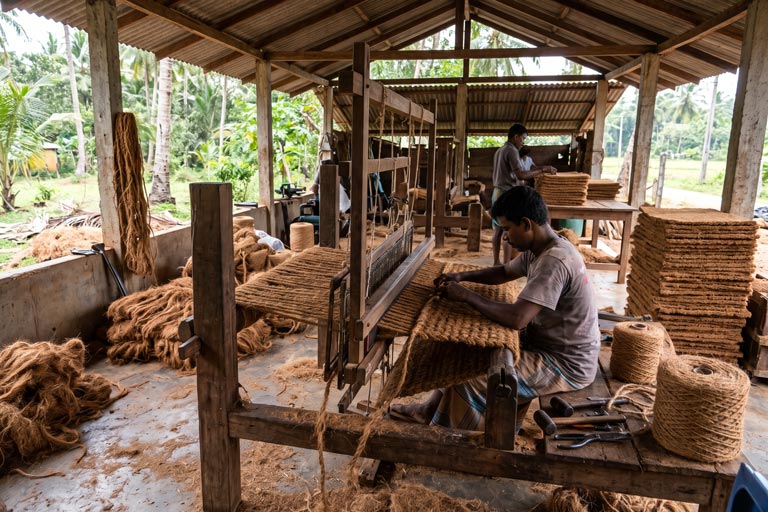
If you have spent any time sourcing entrance matting, you have noticed that coir doormat manufacturers in Sri Lanka keep appearing in your search results, sitting alongside suppliers from India and Vietnam. There is a reason for that, and it is not marketing. The island has been spinning and weaving coconut fibre commercially for well over a century, and a lot of the machinery and the hand skills that make a good mat simply have not been replicated at scale anywhere else.
That said, country of origin tells you almost nothing about whether a specific factory will get your order right. So let us talk about what actually separates a supplier worth a container from one that will cost you a season of returns.
Not all coconut fibre is the same, and the difference shows up in the mat within weeks of it hitting a doorway.
Bristle fibre is the long, stiff, straight fibre pulled from mature brown husks. It is what gives a mat its scraping action, the thing that actually takes mud off a boot. Mattress fibre is shorter, curlier and softer. It has its uses, but a mat made predominantly from it goes limp, sheds and flattens under traffic.
You want to know the blend. A supplier who cannot tell you the bristle content of the yarn going into your mat is either not controlling it or not willing to discuss it, and neither answer is encouraging. Ask, and ask early, because it costs nothing at enquiry stage and costs a great deal at the port.
Almost every mat you will be offered falls into one of these families, and they behave very differently.
Yarn woven into a flat mat, usually with a thicker pile on the traffic face. These are the traditional product, they wear evenly, and they are the easiest construction to produce in unusual sizes. Handwoven pieces carry small irregularities, which some retail buyers treat as a defect and others deliberately market as a feature.
Fibre bonded to a natural latex sheet. The backing stops the mat creeping across a smooth floor and holds the fibre in place, which cuts shedding noticeably. Latex is the choice where compostability matters, since it is a plant derived material, though it does perish faster than the alternative in constant wet.
The commercial workhorse. A vinyl backing gives the mat weight, grip and water resistance, and it takes moulded shapes and printed designs cleanly. The trade off is straightforward: the mat is no longer fully biodegradable. If your retail positioning leans on sustainability messaging, that matters. If you are supplying office building entrances, it usually does not.
Stiff bristle set into a heavier base, built for high footfall and heavy soil. Think building lobbies, school entrances, anywhere in a wet climate where a domestic mat would be saturated by ten in the morning. Higher unit price, considerably longer service life.
The core retail sizes are fairly settled: around 40 by 60 centimetres for the small format, 45 by 75 for the standard, and 60 by 90 for the larger domestic mat. Those three cover the great majority of household demand in most markets.
Beyond that it gets market specific. North American buyers ask for shaped and printed mats more often, seasonal designs particularly, and they buy a noticeably higher proportion of the larger format. European buyers lean towards plain and undyed, and there is steady demand for half round shapes. Middle Eastern buyers tend towards heavier commercial specifications. Any competent factory will produce custom dimensions, but custom sizes usually carry a mould charge or a loom setup charge, so raise it at enquiry rather than after you have agreed a price.
This list has saved buyers a lot of grief. None of these questions are unreasonable and a serious factory will answer all of them without hesitation.
This is where the sourcing conversation usually turns interesting, because the margin on a plain mat is thin and the margin on a branded or designed mat is not.
Most established factories will print your artwork, produce a custom shape, match a backing colour and pack into your own branded sleeve or carton. The practical constraints are worth knowing up front. Print detail on coir is limited by the fibre surface, so fine gradients and small text do not reproduce well; bold shapes and clear lettering do. Custom moulds carry a tooling charge and a lead time of several weeks. And minimum quantities apply per design, not per order, which is the single most common thing new buyers get wrong. Six designs in one container means six separate minimums to satisfy.
Doormat demand is seasonal in most northern markets. Retail sell through climbs sharply from early autumn as the weather turns, which means your buyers want stock on shelf in late summer, which means production needs to be booked in spring.
Factories fill their capacity for that window early. A buyer arriving in July asking for an August shipment is competing for whatever slots are left, and paying for the privilege. Place the seasonal order in the first quarter and the same factory becomes noticeably more flexible on specification, on packaging and on price.
A housewares importer in Germany described their experience in a way that stuck with us. I used this as a replacement for a synthetic entrance mat range that our retail customers had started pushing back on, and the sell through in the first autumn was ahead of the range it replaced, which almost never happens with a substitution.
Our customers are really happy with the consistency between containers more than anything else, and they tend to say the same thing: the second shipment looked like the first one. That sounds like a low bar until you have received a second shipment that did not. Working with an established quality fibre and coir products supplier rather than a trading intermediary is usually what makes that consistency possible, because the yarn specification stays under one roof.
Pull a sample from several cartons, not just the ones at the door. Weigh a mat and compare it against the agreed pile weight, since underweight product is the most common quiet shortfall. Flex the backing to check for cracking. Rub a damp white cloth across a dyed mat to check for colour transfer. And look at the edges, because binding and edge finish is where a rushed run shows itself first.
None of this takes long, and doing it on the first two containers from a new factory establishes a standard that tends to hold afterwards.
Sri Lanka sits among the largest coir exporting nations, and the local fibre carries a high lignin content that gives it stiffness and a longer working life. Coco coir is a byproduct of coconut food processing rather than a purpose grown crop, which is a large part of its appeal to retail buyers building a sustainability story. Add the port at Colombo, with direct sailings to Europe, North America, the Gulf and East Asia without transhipment, and the logistics work out more simply than the map suggests.
Most exporters work to one twenty foot container as the commercial minimum, but the figure that catches buyers out is the minimum per design. Each printed design, shape or custom size carries its own minimum, so a container split across many designs may not be accepted even if the total volume is fine.
The three common retail sizes are approximately 40 by 60 centimetres, 45 by 75 centimetres and 60 by 90 centimetres. Larger commercial entrance mats and custom dimensions are produced to order, usually with a mould or loom setup charge.
Latex is a plant derived backing that keeps the mat compostable and holds the fibre well, but it perishes faster in constant wet. PVC is a vinyl backing that adds weight, grip and water resistance and takes printing cleanly, at the cost of full biodegradability.
Yes, and most established factories offer it. Bold shapes and clear lettering reproduce well on coir; fine gradients and small text do not, because the fibre surface limits detail. Custom moulds carry a tooling charge and add several weeks to lead time.
A domestic mat in normal household use typically gives one to three years before the pile flattens noticeably. Commercial brush and scraper constructions last considerably longer under heavy footfall. Life is shortened by constant saturation, so a covered position always outlasts an exposed one.
Plain woven mats and latex backed mats are, since both the fibre and the natural latex break down. PVC backed mats contain a vinyl layer that does not, so specify the backing material where compostability is part of your product claim.
For autumn and winter retail, book production in the first quarter of the year. Factory capacity for the seasonal window fills early, and buyers arriving in midsummer end up competing for leftover slots on worse terms.