BEST COIR
PRODUCTS
SUPPLIER
Location
No.09, Pengiriwatte Mawatha, Mirihana, Nugegoda,
Colombo, Western Province, Sri Lanka.
Contact
+94 (0)76 791 4088
marketing@ecotrends.lk
BEST COIR
PRODUCTS
SUPPLIER
Location
No.09, Pengiriwatte Mawatha, Mirihana, Nugegoda,
Colombo, Western Province, Sri Lanka.
Contact
+94 (0)76 791 4088
marketing@ecotrends.lk
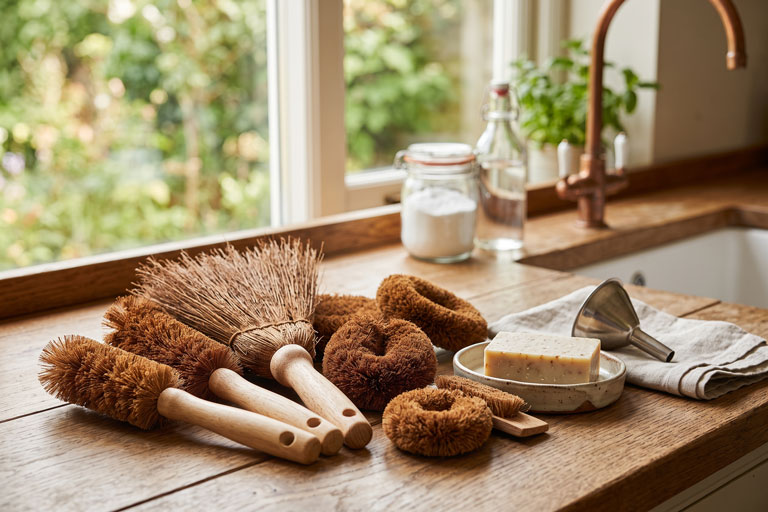
Nature has a funny habit of solving problems before we even know we have them. Long before anyone worried about microplastics in dishwater or landfills full of synthetic sponges, the coconut palm was already producing the answer. Wrapped around every coconut, between the hard shell and the smooth outer skin, sits a thick layer of golden fiber. That fiber is coconut coir, and it happens to be the best natural cleaning material on the planet.
Bold statement? Maybe. But by the end of this article, I think you’ll agree the coconut earned it.
Coir (pronounced “koy-er”) is the coarse fiber extracted from coconut husks. Each husk contains thousands of individual fibers, ranging from four to twelve inches long, that protect the coconut as it falls from the tree and even help it float across oceans to sprout on distant shores. A material tough enough to survive a thirty-foot drop and a sea voyage was always going to handle your dirty dishes.
People figured this out a very long time ago. Coir rope and matting appear in records from South Asian and Arab traders going back centuries, and the fiber’s full story spans shipbuilding, floor mats, mattresses, agriculture, and yes, scrubbing brushes. Sri Lanka and southern India remain the heartland of coir production today, where the craft of separating, cleaning, and spinning the fiber has been refined over generations.
There are two main types. Brown coir, harvested from mature coconuts, is thick, strong, and springy. This is the cleaning fiber. White coir, from younger green coconuts, is softer and finer, better suited to ropes and mats. When you pick up a coir scrub brush, you’re holding brown coir at its best.
Here’s the thing about cleaning. It’s not magic, it’s mechanics. Removing dried food, grease, and grime requires friction applied at the right stiffness. Too soft and you’re just polishing the dirt. Too hard and you scratch the surface underneath. Coir sits in a sweet spot that engineers would struggle to design from scratch.
Coir fibers contain around 45 percent lignin, one of the highest levels of any natural fiber. Lignin is the stuff that makes wood woody. It gives each fiber a firm, springy structure that bites into grime and bounces back to shape, scrub after scrub. Cotton has almost no lignin, which is why a cotton cloth wipes but never scrubs. Coir scrubs.
Despite that stiffness, coir is still softer than metal and most ceramics, so it won’t scratch enamel, stainless steel, glass, or seasoned cast iron the way steel wool does. It cleans burnt pots without leaving those fine gray scratch marks that steel scourers gift to every pan they touch.
Coir absorbs very little water into the fiber itself, which means brushes dry fast and stay fresh. Compare that with cellulose sponges, which soak up water and hold it in their pores for days. Fast drying is the single biggest reason coir tools resist the bacterial funk that makes sponges smell.
This fiber evolved to survive floating in the ocean. Household use is a holiday by comparison. Coir resists rot, mildew, and salt damage far better than jute, hemp, or sisal, which is why it was the fiber of choice for marine ropes for centuries.
Let’s put coir up against the competition, because claims are cheap and comparisons are useful.
Coir vs. plastic sponges: the sponge sheds microplastics from day one, harbors bacteria within a week, and sits in landfill for centuries. Coir sheds nothing harmful, dries too fast for bacteria to thrive, and composts within months. It also simply lasts longer. This one isn’t close.
Coir vs. steel wool: steel wool cuts through heavy grime, no argument there. But it rusts within days, sheds sharp metal slivers, and scratches almost every surface. Coir handles ninety percent of the same jobs with none of those problems, and for the last ten percent, a little baking soda closes the gap.
Coir vs. loofah: loofah is wonderful, and I recommend it for delicate glassware. But it’s too soft for serious scrubbing. Think of loofah and coir as teammates rather than rivals. One washes the wine glasses, the other rescues the burnt curry pot.
Coir vs. walnut or plant fiber pads: these are decent products, but most are bonded with synthetic resins or backed with plastic foam, which quietly ruins their eco credentials. A pure coir brush needs no glue or backing. The fiber’s own springiness holds it together.
You see the pattern. Other materials win single categories. Coir wins the ones that matter most, all at once.
There’s something worth appreciating in how this material reaches your sink. In Sri Lanka, coconut husks are first soaked to loosen the fibers, a process called retting. The fibers are then separated, cleaned, dried in the sun, and sorted by length and thickness. The longest, springiest bristle fiber goes to brush makers, who bind it into brushes, brooms, and scourer pads, often by hand using methods passed down through families.
I find that supply chain refreshing. The husks are a byproduct of the coconut food industry, so nothing extra is grown or cut down to make your brush. The waste of one industry becomes the raw material of another. That’s what a circular economy actually looks like in practice, not in a corporate slideshow.
One of our wholesale buyers in Germany told us, “Our customers are really happy with the coir brushes, and they said the quality is nothing like the mass-market ones they’d tried before. The fiber feels denser and nothing sheds.” That difference comes from fiber grade and binding craft, which is why sourcing from origin matters. A quality fiber and coir products supplier like ECO TRENDS works directly with Sri Lankan coir at the source, and businesses can contact us for fiber and coir products in wholesale volumes.
The cleaning story doesn’t stop at dishes, and it would be a shame to leave the rest out.
Doormats are the classic. Coir’s stiffness scrapes mud off boots better than any synthetic mat, which is why coir doormats have guarded doorsteps for over a century. In the garden, coir brushes clean tools, pots, and greenhouse surfaces without introducing chemicals near your plants. Coir pads scrub barbecue grates. Coir brooms sweep patios. Some people even polish hardwood floors with coir, an old trick from colonial-era households that still works.
And here’s a fun sidebar: the same fiber, in its finer forms, is used as a growing medium in hydroponic farming and as an ingredient in mattresses. One husk, a dozen industries. The coconut doesn’t waste anything, and neither should we.
Switching is refreshingly simple. Start with one coir scrub brush and use it until your last plastic sponge dies of natural causes. Add a coir scourer pad for heavy jobs and maybe a small tawashi style brush for vegetables. Rinse them after use, dry them bristles down, and pour boiling water over them once a week.
Total cost? Less than a few months of disposable sponges. Total plastic added to the ocean? Zero. Sometimes the best material for the job has been hanging on a palm tree all along.
Before we wrap up, let’s clear the air on a few claims that float around about natural fiber, because some of them stop people from making the switch.
Myth one: natural fiber tools are unhygienic. People assume anything organic must grow germs faster. The truth runs the other way. Bacteria need trapped moisture, and coir’s fast-drying open structure denies them exactly that. It’s the water-hoarding synthetic sponge that turns into a petri dish, not the brush that’s bone dry by lunchtime.
Myth two: they fall apart quickly. This one comes from people who bought a bad brush once. Low-grade brushes made from short waste fiber do shed and collapse, no argument. But a properly made brush using long bristle fiber and tight binding will outlast a whole drawer of sponges. Quality varies in natural products the same way it does in everything else, so buy from makers who know the fiber.
Myth three: natural means weak. Tell that to the sailors who trusted coir rope to hold ships at anchor, or to anyone who has scrubbed a blackened grill grate with a coir pad. Lignin-rich coir is one of the toughest plant fibers in existence. It doesn’t need to apologize to plastic for anything.
Once those three fall away, the case against switching gets pretty thin.
Coir has one of the highest lignin contents of any natural fiber, which gives it a rare mix of stiffness, spring, and rot resistance. It scrubs harder than loofah, cotton, or jute, dries faster than cellulose, resists bacteria, and lasts months of daily use.
Coir is firm enough to remove burnt food but softer than metal and ceramic, so it won’t scratch stainless steel, enamel, glass, or seasoned cast iron. For delicate nonstick coatings, use lighter pressure or a softer fiber like loofah.
A coir scrub brush typically lasts three to six months of daily kitchen use, and coir doormats last for years. Rinsing after use and allowing the fiber to air dry are the keys to a long life.
Yes, completely. Coir is pure plant fiber and breaks down fully in a compost bin, usually within several months to a year depending on conditions. Its high lignin content means it degrades slower than food scraps but leaves nothing harmful behind.
Very much so. Coir is made from coconut husks, a byproduct of the coconut food industry, so no additional land or trees are used. Production supports farming communities in countries like Sri Lanka, where coir craftsmanship is a generations-old trade.
Sri Lanka and southern India produce the majority of the world’s high-grade coir. Sri Lankan brown coir in particular is prized for brush making because of its long, springy bristle fibers and traditional processing methods.