
BEST COIR
PRODUCTS
SUPPLIER
Location
No.09, Pengiriwatte Mawatha, Mirihana, Nugegoda,
Colombo, Western Province, Sri Lanka.
Contact
+94 (0)76 791 4088
marketing@ecotrends.lk
BEST COIR
PRODUCTS
SUPPLIER
Location
No.09, Pengiriwatte Mawatha, Mirihana, Nugegoda,
Colombo, Western Province, Sri Lanka.
Contact
+94 (0)76 791 4088
marketing@ecotrends.lk
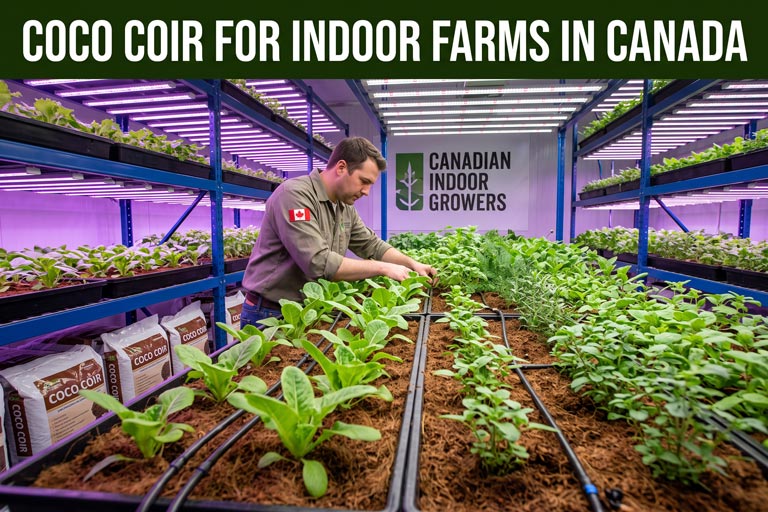
Indoor farming has grown up. What started as a niche experiment in warehouse corners has turned into a serious slice of how Canada feeds itself through long, dark winters. And behind a surprising number of those glowing grow racks sits a humble material. Coco coir for indoor farms Canada growers depend on has become a quiet backbone of the movement, and once you understand why, it is hard to look at a bag of it the same way again.
Let me explain what makes it click, because the reasons are more practical than glamorous, and that is exactly the point.
Canada is a tough place to farm outdoors for large chunks of the year. Snow, short daylight, freeze thaw cycles that wreck soil structure. So growers moved the whole operation inside, into controlled environments where temperature, light, and humidity are dialled in by hand. In that world the growing medium is not just dirt substitute. It is a precision component.
Soil is heavy, messy, and unpredictable indoors. It compacts, it harbours pests, and it varies from bag to bag. Coir, on the other hand, arrives clean, light, and consistent. For vertical systems where every kilogram on the rack matters, that lightness is not a nice to have. It is structural. A fully stacked tower of soil filled trays gets heavy fast, and cold climate controlled environment coir keeps that load manageable.
Here is where coir really earns its keep. The material holds a remarkable amount of water relative to its weight, yet it drains freely and keeps plenty of air around the roots. That balance is the holy grail for indoor growing, where overwatering in a sealed room is a genuine risk and root rot loves stagnant conditions.
Think about a vertical farm running dozens of shelves. If your medium held water unevenly, the top rows might dry out while the bottom ones drown. Coir growing media for vertical farming smooths that out because it wicks and releases moisture in a steady, predictable way. One operator running a leafy greens facility told us, "I used this as the base across our entire rack system and the moisture uniformity from top shelf to bottom was the thing that finally let us automate irrigation properly."
That automation point is bigger than it sounds. When a medium behaves predictably, you can trust your sensors and timers. When it does not, you are forever babysitting.
Shipping container farms have popped up all across Canada, from restaurant back lots to remote northern communities where fresh produce is genuinely hard to get. These modular units are basically farms in a box, and they live or die on efficiency. Every input has to pull its weight.
Coco coir for container farming Canada operators favour ships compressed, which is a huge deal when your growing space is a forty foot metal box. A small stack of compressed blocks rehydrates into a season's worth of medium, so you are not sacrificing precious square footage to storage. Add water, watch it expand, fill your channels, and you are growing. Simple, and simple scales.
There is something genuinely satisfying about a system this tight. No waste, no drama, just a clean loop from block to harvest. For remote operations especially, the reduced shipping bulk is not a minor perk. It can be the difference between viable and not.
Not everything belongs on a rack, but a lot does. Leafy greens are the obvious champions. Lettuce, kale, arugula, and the whole salad family root quickly and love the airy structure that coir provides. Coco coir for leafy greens indoor setups tends to produce clean, fast, uniform heads, which is exactly what a restaurant or grocery contract demands.
Microgreens deserve a special mention. They are harvested young and eaten whole, so a clean, low salt medium is non negotiable. Indoor hydroponic coir substrate that has been properly washed gives growers the peace of mind that what feeds the crop is not carrying anything unwanted.
Commercial indoor farming is a numbers game. Yield per square metre, cycles per year, uniformity across the batch. And uniformity starts with the medium. If your coir varies wildly from one shipment to the next, your whole calibrated system wobbles.
This is why sourcing matters so much. A quality fiber and coir products supplier tests batches, controls the wash, and keeps EC and pH inside a tight window shipment after shipment. Our customers are really happy with that predictability, and one facility manager said, "the batch to batch consistency meant we stopped having to re tune our nutrient dosing every time a new pallet arrived." That is real operational time saved.
Coir has a well documented place in horticulture, and if you want the neutral background on the material and its origins, Wikipedia lays it out clearly. Understanding where it comes from helps you appreciate why the processing quality varies so much between suppliers.
Indoor farms already carry a sustainability story, growing food close to where it is eaten, cutting transport miles, using water efficiently. Coir fits that ethos neatly. It is a byproduct of coconut processing, so choosing it keeps husk waste out of landfills and spares the peat bogs that conventional media so often plunder.
And because coir can be reused across multiple cycles with proper treatment, the loop tightens further. For Canadian operators building a brand around clean, local, responsible food, the medium underneath the crop being sustainable too is a quiet but meaningful part of the story. It is one of those details that customers increasingly ask about.
Let us be honest about something. Indoor farming is expensive to run. Lights, climate control, labour, rent on climate ready space. Margins are tight, and every input gets scrutinised. So when growers stick with coir despite cheaper looking options on the shelf, it is not sentiment. It is math.
A predictable medium reduces crop failures, and a single failed batch on a rack can wipe out weeks of overhead with nothing to sell. Coir's consistency means fewer surprises, and fewer surprises means the financial model actually holds. Add in the reusability across cycles and the compressed shipping that cuts freight and storage, and the total cost picture looks a lot friendlier than the sticker price alone suggests. The cheapest bag is rarely the cheapest crop.
There is a labour angle too. Clean, lightweight, uniform medium is faster to handle. Filling trays, moving racks, cleaning up between cycles, all of it goes quicker when you are not wrestling heavy, messy soil. On a commercial floor where labour is often the biggest line item after energy, those saved minutes add up across thousands of trays a year.
Indoor growing is a system, and the medium is one gear in a larger machine. Your lights drive photosynthesis, your airflow manages humidity and strengthens stems, and your medium feeds and anchors the roots. When one gear is unreliable, the others cannot compensate fully.
This is why growers who invest heavily in premium LEDs and tight climate control tend to be fussy about their coir too. It would be strange to spend a fortune on lighting and then let an inconsistent medium undermine the whole rig. Balanced water holding also plays nicely with airflow, since a medium that does not stay soggy reduces the humidity spikes that invite mould in a sealed room. Everything connects, and coir slots into that web of dependencies without fuss, which is exactly what a busy commercial grower wants.
A few practical notes before you fill your first tray. Rehydrate compressed blocks with clean, pH adjusted water and let them expand fully before use. Do not rush it. Give the medium a chance to reach its true volume, because half hydrated coir behaves oddly.
Match your irrigation to coir's fast draining nature. Indoor systems often run little and often, and coir loves that rhythm. Keep an eye on runoff EC to catch any salt drift early. None of this is complicated, but getting it dialled in from day one saves a lot of second guessing later. If you want to talk through what format suits your particular rack or container layout, it makes sense to contact a fiber and coir products team who can point you to the right product.
For anyone who likes to verify their materials against a formal reference, the coir entry on Wikidata links the substrate to its wider agricultural classification, which is handy for procurement documentation.
Yes, exceptionally so. Its light weight reduces load on stacked racks, and its balanced water holding and drainage keep moisture even across every shelf. That predictability is what lets vertical operators automate irrigation with confidence.
Coir arrives clean, light, and consistent, unlike soil which compacts, harbours pests, and varies between bags. In cold climate controlled environments where precision matters, coco coir for indoor farms Canada growers use delivers reliable, repeatable results.
Leafy greens, culinary herbs, strawberries, and microgreens all perform well. Fast rooting crops with high turnover suit coir especially, since the airy structure encourages quick establishment and clean harvests.
It ships compressed into blocks or bricks that rehydrate on site. This saves enormous storage space inside a container unit, since a small stack expands into a full season of usable medium once water is added.
It can, with proper flushing and treatment between cycles. Reusing coir stretches your budget and strengthens the sustainability story that most indoor farms are building their brand around.