
BEST COIR
PRODUCTS
SUPPLIER
Location
No.09, Pengiriwatte Mawatha, Mirihana, Nugegoda,
Colombo, Western Province, Sri Lanka.
Contact
+94 (0)76 791 4088
marketing@ecotrends.lk
BEST COIR
PRODUCTS
SUPPLIER
Location
No.09, Pengiriwatte Mawatha, Mirihana, Nugegoda,
Colombo, Western Province, Sri Lanka.
Contact
+94 (0)76 791 4088
marketing@ecotrends.lk
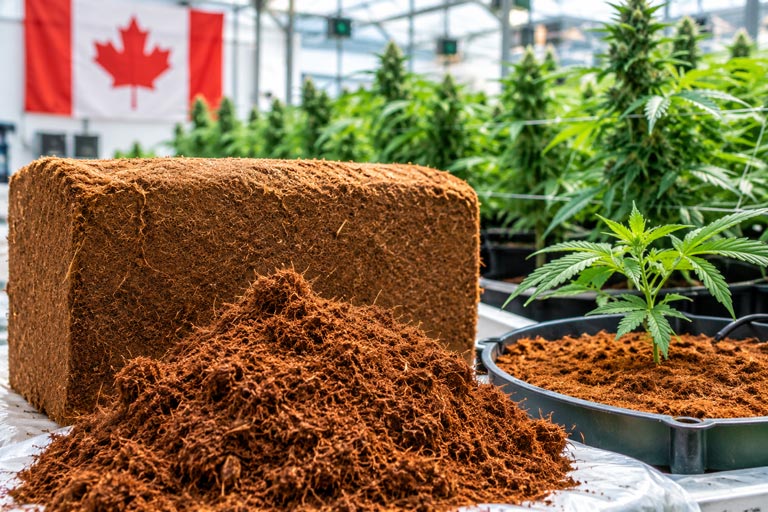
Ask any grower who has switched from peat, and they will tell you the same thing. The medium makes or breaks the season. That is why buffered cocopeat for cannabis Canada operators keep coming back to has quietly become one of the most talked about growing media in licensed rooms from Ontario to British Columbia. It holds water like a sponge, drains fast enough to keep roots breathing, and, when it is prepped right, behaves in a way that is honestly hard to match.
Here is the thing though. Not all coir is created equal, and the word "buffered" hides a lot of chemistry that growers really should understand. So let us walk through it properly, the way a friend who has ruined a crop or two might explain it to you over coffee.
Coconut fibre and pith come from the husk of the coconut, soaked and processed near the coast. Sounds harmless, right? The catch is that this material naturally clings to sodium and potassium, and it carries a stubborn cation exchange capacity that loves to swap ions with your feed. Drop unbuffered coir into a cannabis run and it will grab calcium and magnesium straight out of your nutrient solution, leaving your plants hungry even though the reservoir reads perfect.
You know what that looks like in the room? Rusty spotting on the leaves, interveinal yellowing, and a grower scratching their head at 2am wondering why cal mag deficiency showed up in week three. Been there. It is maddening because the numbers all say you are doing everything right.
Buffering fixes this. The coir gets soaked in a calcium and magnesium rich solution before it ever reaches you, so those exchange sites are already saturated. When your feed comes in, the medium is not fighting you for nutrients anymore. It is a small step in the factory that saves an enormous headache in the tent.
Electrical conductivity, or EC, tells you how much salt is floating around in the medium. Fresh from the husk, poorly washed coir can carry an EC north of 2.0 mS/cm, which is basically a salt bath for young roots. Quality washed material sits comfortably below 1.0, and the better producers get it lower still.
Why does this matter so much for cannabis specifically? Seedlings and clones are fragile. A high salt environment stresses them right when they need to be putting energy into rooting. Low EC coir pith for cannabis gives those early roots a clean, calm place to establish, and clean starts almost always mean stronger finishes.
One master grower we supply put it plainly. He said, "I used this as my base for a full run of autoflowers and the uniformity across the canopy was the best I had seen in years. No hot spots, no laggers." That kind of consistency is gold when you are running commercial cycles where every plant needs to hit harvest together.
Canada is a serious cannabis market, and Canadian growers tend to be picky in the best way. The cold climate means most cultivation happens indoors or in heated greenhouses, so the medium has to perform under tightly controlled conditions where there is nowhere to hide. Buffered cocopeat for cannabis Canada producers choose usually shows up in one of a few formats.
The compressed format is a favourite for a boring but real reason. Freight. A single pallet of compressed blocks rehydrates into several pallets worth of usable medium, which matters a lot when you are importing from across the ocean. Smart logistics is half the game.
When you evaluate a supplier, a few numbers tell you almost everything. Look for EC below 1.0, pH sitting in the friendly 5.8 to 6.5 band, and a stated calcium magnesium buffering treatment. Ask about the wash. Ask how many times the material was rinsed and whether they test each batch.
Certifications help too. Calcium buffered coco coir Canada buyers trust often carries recognised horticultural standards, and reputable suppliers will happily share lab results. If a seller gets cagey when you ask for a batch report, that tells you something. Coco coir itself has a long, documented agricultural history, and you can read a solid neutral overview of the material on Wikipedia if you want the background before you commit.
Honestly, the willingness to share data is a better trust signal than any glossy brochure. A quality fiber and coir products supplier should treat transparency as normal, not a favour.
There is a quiet environmental win baked into coir that peat simply cannot offer. Peat harvesting drains ancient bogs that took millennia to form. Coconut husk, by contrast, is a byproduct of an industry that was going to produce coconuts anyway. Using it keeps a waste stream out of landfills and gives it a second life feeding plants.
And you can reuse it. With proper flushing and a fresh buffering treatment between runs, many growers get two or three cycles from the same medium. That stretches the budget and shrinks the footprint at the same time. For a market as environmentally conscious as Canada's, that combination lands well.
Let me save you some pain. First, do not assume buffered means you can skip cal mag entirely. Buffering evens the playing field, but cannabis is a hungry plant and still appreciates supplemental calcium and magnesium during heavy flower. Second, do not let the medium dry out completely. Coir is forgiving, but bone dry pith becomes weirdly hydrophobic and takes real effort to rewet evenly.
Third, and this one trips up newcomers, watch your watering frequency. Coir drains faster than soil, so it often wants little and often rather than big soaking floods. Once you get the rhythm, though, the plants respond fast, and that responsiveness is exactly why so many commercial rooms have made the switch.
Our customers are really happy with the batch consistency, and one grower in a licensed facility told us, "the roots colonised the medium faster than anything we had run before, and cleanup at the end was genuinely easier." Small things, but they add up over a full commercial cycle.
One thing that catches new growers off guard is how much the surrounding environment shapes coir's behaviour. In a cool Canadian grow room during winter, the medium holds moisture longer because evaporation slows right down. Come summer, when the room warms and the fans work harder, that same coir dries out noticeably faster. Same bag, same plants, completely different watering rhythm depending on the season.
This is not a flaw. It is just physics, and once you clock the pattern you can work with it. Many commercial rooms adjust their irrigation schedules seasonally for exactly this reason, leaning on runoff readings and simple moisture meters rather than guessing. The medium is talking to you, in a sense. You just have to learn its language, and coir happens to be a pretty honest communicator once you tune in.
Root zone temperature deserves a mention too. Cannabis roots sulk in cold medium, and in a Canadian basement grow the floor can get genuinely chilly. Some growers sit their pots on gentle heat mats or raise them off cold concrete, and the coir, being light and airy, responds quickly to that little bit of warmth. Small adjustment, real difference in early vigour.
Coir is not one uniform thing. It comes as fine pith, coarser chips, and longer fibre, and the blend you choose changes how the root zone drains and breathes. A pith heavy mix holds more water, which suits growers who cannot water frequently. A chip heavy blend drains faster and packs in more air, which flowering cannabis often loves during its thirsty final weeks.
Plenty of commercial operators settle on a mix that leans toward coarser material precisely because it forgives the odd overwater and keeps roots oxygenated. If you are running a high frequency automated feed, the extra drainage is your friend. Getting this balance right is one of those quiet decisions that separates a decent grow from a genuinely great one, and a good supplier will happily talk you through which blend fits your feeding style.
Most premium coir originates in tropical coastal regions, with Sri Lanka standing out for its long processing heritage and strict washing practices. The material there gets rinsed thoroughly, buffered carefully, and tested before it ships. If you want to line up supply or just talk through what format suits your setup, it is worth reaching out to a specialist rather than gambling on a random marketplace listing. You can contact a fiber and coir products team directly to work through the details.
For the technically curious, the structured data entry for coir on Wikidata is a handy reference point that ties the material to its broader agricultural classification.
Aim for an EC below 1.0 mS/cm. Anything higher means residual salts that can stress young roots. Reputable suppliers wash their material repeatedly to hit this target and will provide a batch test to prove it.
Usually yes, at least during flower. Buffering stops the medium from stealing calcium and magnesium from your feed, but cannabis remains a heavy feeder. Think of buffering as removing an obstacle, not as replacing your nutrient plan.
It can. Flush the medium thoroughly, re-buffer with a calcium magnesium solution, and inspect for salt buildup. Many growers get two or three runs before quality drops, which helps both cost and sustainability.
Canada's cold climate pushes cultivation indoors and into heated greenhouses, where a stable, predictable medium is essential. Calcium buffered coco coir Canada growers use delivers that reliability, along with strong drainage and reusability.
Regular coir straight from processing can hold sodium, potassium, and residual salts, and it will pull calcium and magnesium from your feed. Buffered cocopeat has been pre soaked in a calcium magnesium solution so it no longer competes with your nutrients, giving far steadier results.